Carbon + Cost: Linking Energy Baselines to ROI Without Fake Savings
Why “fake savings” happen (and why everyone gets burned)
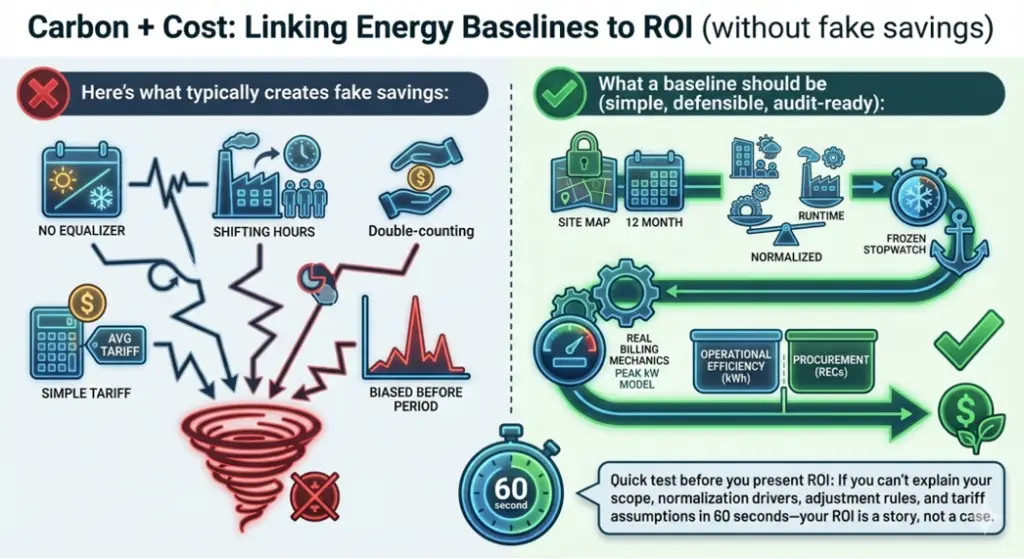
Fake savings usually come from one of these baseline traps:
Wrong comparison point: Comparing a hot month to a mild month without normalization.
Operational drift ignored: Occupancy, production, schedule, and setpoints changed—yet the baseline stayed frozen.
Double counting: Savings claimed in the project and again in operational improvements or another initiative.
“Before” data is biased: Using abnormal high-consumption periods (equipment faults, temporary loads, commissioning issues).
Tariff fantasy: Using an average blended rate that doesn’t match actual billing structure (demand charges, TOU, slab rates).
If your ROI story depends on any of the above, it’s not ROI—it’s a narrative.
The baseline that actually stands up in a meeting
A baseline isn’t “last year’s kWh.” A baseline is a defensible model of expected consumption under stated conditions.
Step 1: Lock the scope like a contract
Define what is in/out before you calculate anything:
Facility boundary (single building? whole site? common areas?)
Energy types (electricity, gas, diesel, chilled water)
Meter sources (utility invoice, submeters, BMS)
Time window (ideally 12 months, minimum 3–6 months with justification)
Rule: No scope clarity = no ROI.
Step 2: Normalize the baseline (so it reflects reality)
Pick the right normalization driver:
Buildings: Cooling degree days (CDD), occupancy, operating hours
Industry: Production throughput, batch count, runtime hours
Mixed-use sites: Segment by load type (HVAC vs process)
You don’t need “fancy models.” You need simple, transparent logic:
kWh per m² (only useful if occupancy and schedules are stable)
kWh per operating hour
kWh per unit output
Weather-normalized HVAC energy (CDD-based)
Rule: If the driver moves and your baseline doesn’t, your savings are probably fake.
Step 3: Build an “adjusted baseline” policy (the part everyone skips)
This is where serious ROI lives.
Create rules for baseline adjustments when conditions change:
New tenant / changed occupancy
New equipment added
Schedule changes (night shift, extended hours)
Setpoint policy changes
Process throughput changes
Rule: Don’t “freeze the baseline” forever. Freeze the method, not the number.
Turning baseline into ROI—without wishful thinking
Now connect energy to cash with discipline.
Step 4: Use real billing mechanics, not averages
Energy cost is rarely just kWh × rate.
Include:
Demand charges (kW peak)
Time-of-use pricing
Fuel price variability (if relevant)
Power factor penalties (where applicable)
Rule: A project that saves kWh but increases peak demand can look good on paper and fail on the bill.
Step 5: Carbon accounting: keep it clean and auditable
For carbon (Scope 2), state:
Grid emission factor source (location-based; market-based if applicable)
Year and methodology
Any renewable instruments clearly separated (no blending unless you can evidence it)
Rule: Don’t “greenwash the baseline.” If carbon is reduced via procurement, don’t claim it as operational efficiency.
A practical mini-example (clean math, no drama)
Let’s say your baseline is 1,000,000 kWh/year.
You implement HVAC optimization and expect 10% reduction:
Expected savings = 100,000 kWh/year
But after implementation:
Occupancy increases 15%
Operating hours increase 10%
If you compare raw kWh, you may “see” no savings (or worse, an increase).
A proper approach compares normalized intensity (e.g., kWh per operating hour, or weather-normalized HVAC kWh). That’s how you show:
The building got busier,
Yet the system became more efficient,
And the savings are real.
This is how you prevent “ROI fights” later.
The ROI integrity checklist (use this before presenting)
If you can’t answer these clearly, pause the ROI claim:
Do we have a defined baseline period and data quality check?
Have we normalized for weather/occupancy/throughput?
Do we have an adjustment policy for operational change?
Are we avoiding double counting across initiatives?
Are we using the actual tariff structure and demand impacts?
Is carbon reporting source-based and traceable?
Do we separate operational savings vs procurement-based reductions?
Bottom line
A baseline is not a spreadsheet—it’s governance.
If you treat it like an evidence chain (scope → normalization → adjustments → billing mechanics), your ROI becomes audit-ready, your carbon claims become credible, and your business case survives real-world operations.